
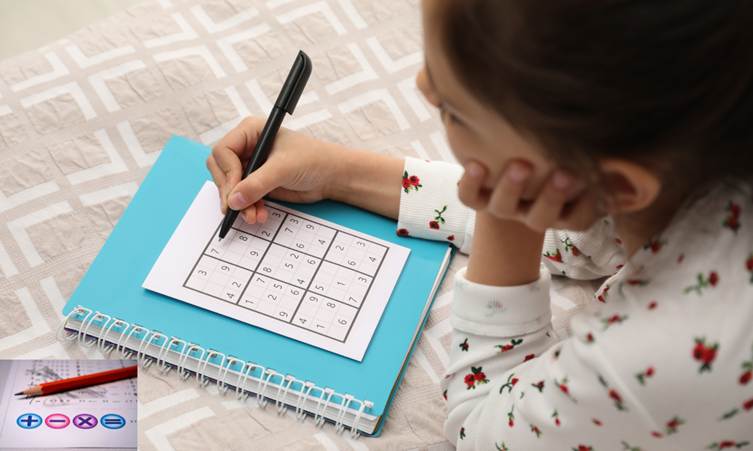
Children begin building maths skills long before they enter school. Everyday play — sorting toys, counting snacks, fitting shapes — becomes the foundation of logical thinking. At FunLivo, our Early Math, Puzzles & Games Worksheets for Kids turn this curiosity into structured, joyful learning. These printable activities blend fun and education, helping children aged two to eight grasp numbers, patterns, and problem-solving through play.
How Early Math and Puzzles Build Foundational Skills
Early maths practice is not about rote counting; it is about discovery. When children explore numbers through puzzles and games, they develop:
- Logical reasoning and sequencing
- Observation and visual-spatial awareness
- Memory, focus, and patience
- Confidence in finding their own solutions
Each worksheet guides children step-by-step — matching shapes, connecting dots, or solving picture puzzles — encouraging independent thinking while strengthening fine-motor control. These Early Math, Puzzles & Games Worksheets for Kids create hands-on experiences that build both logic and creativity.
Why Games Make Learning Maths Fun
Games transform abstract maths into real experiences. Counting blocks, number mazes, or pattern games engage multiple senses and make learning natural. Research shows that playful learning improves concept retention far more effectively than passive memorisation.
Examples of printable activities include:
- Counting animals or fruits
- Number tracing and recognition
- Simple addition puzzles
- Shape-matching and pattern grids
- Memory-based maths games
With Early Math, Puzzles & Games Worksheets for Kids, children build essential problem-solving skills through joyful repetition — learning without pressure.
According to the National Association for the Education of Young Children (NAEYC), playful problem-solving through maths games enhances reasoning and social interaction skills, laying strong foundations for later academic success.
Early numeracy should be taught through hands-on exploration, sorting, and pattern recognition activities to strengthen conceptual understanding.)
Benefits of Early Math Puzzles & Games Worksheets
- Boosts focus, patience, and analytical ability
- Encourages children to connect ideas across subjects
- Promotes confidence through self-paced practice
- Builds readiness for higher-level maths learning
Each worksheet is designed for home or classroom use — printable, simple, and enjoyable. When children solve puzzles, they learn to think critically while having fun.
Enhance your child’s play-based learning with our FunLivo Early Math & Counting Workbook for Preschoolers — a printable PDF that includes tracing, puzzles, and logic games for ages 2–6. Ideal for home learning or classroom reinforcement.
FAQ Section
1. Are maths puzzles suitable for preschoolers?
Yes. Visual puzzles and number games introduce counting, matching, and sequencing in an age-appropriate, enjoyable way.
2. How often should children practise these worksheets?
Two to three short sessions a week are ideal. The goal is engagement, not repetition.
3. Do printable maths activities replace classroom learning?
No. They complement formal teaching by giving children extra opportunities to explore concepts creatively.
Disclaimer
These Early Math, Puzzles & Games Worksheets for Kids educational printables support early childhood learning and creative growth. They are not substitutes for formal instruction or professional educational guidance.