
1. Why Early Childhood (Ages 2–8) Is the Most Important Learning Stage and role of early learning worksheets for kids
The early years form the strongest base for lifelong learning, behaviour, and cognitive development. From ages 2 to 8, children rapidly build skills that support school readiness and long-term academic success.
According to the Harvard University Center on the Developing Child, early experiences shape “brain architecture,” creating neural connections that influence how children learn, behave, and respond for the rest of their lives.
This Harvard resource explains how early interactions and activities strengthen neural pathways during the foundational years.
Development organizations also summarise that the brain reaches about 80% of adult size by age 3 and around 90% by age 5.
This source offers a parent-friendly explanation of early brain growth and why early years are critical for foundational skills.
Because this period is so important, parents and teachers prefer early learning worksheets for kids to build consistent, hands-on learning habits at home or school.
These worksheets support development of:
- Pencil grip
- Fine motor control
- Letter and number understanding
- Listening and attention
- Early maths
- Problem-solving
- Visual–motor coordination
- Daily learning routines
2. Why Worksheets Work So Well for Early Learning

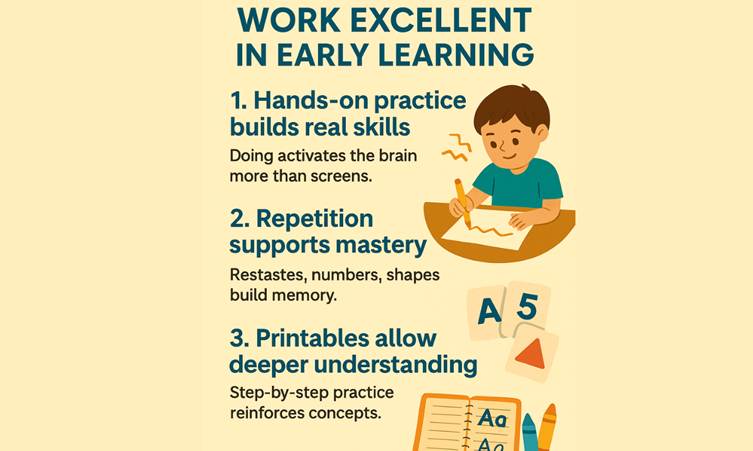
2.1 Hands-on practice builds real skills
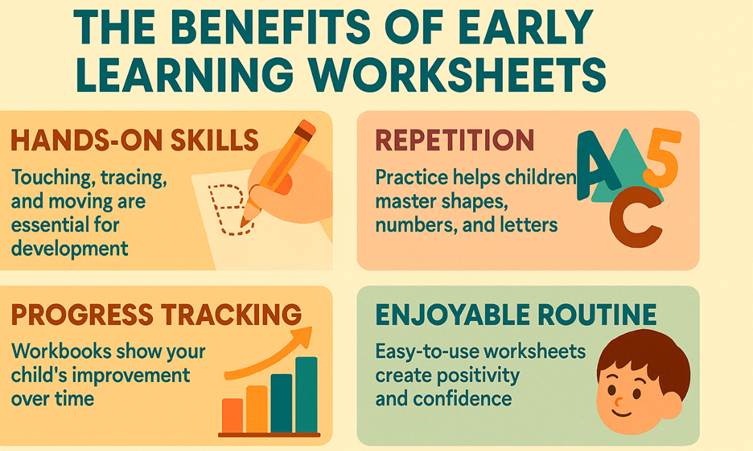
Children learn by doing — touching, tracing, colouring, matching, and writing. Worksheets activate multiple senses and engage motor pathways more deeply than screen-based learning.
A study shared by NIH shows that handwriting and letter formation activate brain regions essential for literacy, memory, and cognitive development.
Source: https://www.nih.gov/news-events/nih-research-matters/learning-write-letters-enhances-letter-recognition
Explanation: This NIH-backed report shows that writing by hand strengthens brain activation compared to only viewing letters.
This is why early learning worksheets for kids remain a preferred tool for preschool and primary education.
2.2 Repetition supports mastery
Young children need repeated exposure to letters, numbers, shapes, and patterns.
The American Psychological Association highlights that spaced, repeated practice improves memory and long-term learning.
This APA article explains how repetition strengthens memory and supports concept mastery.
Worksheets allow repetition through:
- Large tracing
- Small tracing
- Dotted letters and numbers
- Matching
- Counting
- Colouring
- Patterns
2.3 Early learning worksheets for kids reduce screen time
Excessive screen exposure affects children’s attention span, sleep cycles, and behaviour. Worksheets provide a healthy alternative by giving children a tactile, real-world activity. Writing, tracing, and colouring help strengthen fine-motor skills that screens cannot build. Parents also find worksheets easier to monitor compared to mobile apps.
Benefits:
- Reduces overstimulation from screens
- Supports healthy sleep and behaviour
- Improves fine motor control and real-world coordination
2.4 Worksheets are affordable and flexible
Printable worksheets require only paper and pencils, making them one of the most budget-friendly learning tools for Indian families. They can be used at home, school, in travel, or during quiet time. Parents can reprint pages as many times as needed, making practice unlimited without additional cost.
Benefits:
- Very low cost compared to books or classes
- Can be reprinted and reused anytime
- Suitable for home-school and classroom use
3. Why Structured early learning worksheets for kids and Workbooks Are Better Than Random Worksheets
3.1 Workbooks follow a proper sequence
A structured workbook guides a child step-by-step — from simple to moderate to advanced skills. This sequencing prevents confusion and helps children learn in the logical order recommended by educators. Random worksheets downloaded from the internet rarely follow developmental progression.
Benefits:
- Clear learning path
- Reduces gaps in understanding
- Supports independent practice
3.2 Workbooks support deeper understanding
Because workbooks contain related worksheets in one place, children develop concepts gradually and repeatedly. When pages are connected and consistent, learning becomes stronger. Workbooks also make it easier for parents to observe patterns and see which areas need reinforcement.
Benefits:
- Strengthens long-term learning
- Ensures mastery through repetition
- Helps parents track progress easily
3.3 Workbooks save time
Parents do not need to search for matching worksheets or create lessons. Everything is organised — tracing, colouring, numbers, patterns, and more. Teachers also prefer workbooks because they reduce planning time and keep classroom activities structured.
Benefits:
- Saves parents hours of searching
- Makes daily learning smooth
- Helps teachers plan quicker activities
4. What Skills Worksheets Build (Ages 2–8)

4.1 Pre-writing and fine motor skills
Tracing lines, curves, and shapes helps children develop hand strength and pencil control. These skills form the foundation of handwriting and drawing. Consistent pre-writing practice improves grip, stability, and muscle memory.
Benefits:
- Better pencil grip
- Stronger hand muscles
- Smoother handwriting later
4.2 Alphabet knowledge early learning worksheets for kids
Alphabet worksheets introduce children to letter shapes, sounds, and formation. Tracing and colouring letters build familiarity, while matching activities improve recognition. This prepares children for reading and writing in kindergarten and Grade 1.
Benefits:
- Faster letter recognition
- Correct letter formation
- Improves early reading readiness
4.3 Early maths skills
Number tracing, counting objects, matching quantities, and pattern worksheets strengthen early numeracy. These activities develop mathematical thinking in a playful way. Children understand quantity, sequence, and simple logic.
Benefits:
- Strong number sense
- Better counting fluency
- Improved logical reasoning
4.4 Thinking and cognitive skills
Problem-solving worksheets like matching, sorting, mazes, and spot-the-difference improve attention, reasoning, and memory. These tasks activate cognitive processes that digital learning cannot fully replicate.
Benefits:
- Sharper concentration
- Stronger problem-solving
- Improved attention to detail
4.5 Life skills and routines early learning worksheets for kids
Routine charts, habits worksheets, and behaviour printables help children understand daily responsibilities. Visual learning improves discipline and independence. Life skills worksheets also support emotional development through simple, relatable activities.
Benefits:
- Builds independence
- Encourages responsibility
- Supports emotional growth
5. How Worksheets Fit the NEP 2020 Framework in India
India’s National Education Policy (NEP) 2020 promotes activity-based, play-based, and experiential learning for ages 3–8.
NEP 2020 outlines the shift toward foundational literacy and numeracy, hands-on experiences, and structured early learning.
Early learning worksheets for kids directly support NEP goals through:
- Repetition
- Experiential learning
- Foundational literacy and numeracy (FLN)
- Home-based participation
- Affordable access
This makes them a practical tool for Indian classrooms and homes.
6. How Parents Can Use Worksheets Effectively
6.1 Keep sessions short (10–15 minutes)
Young children learn best in short, focused sessions. A 10–15 minutes activity prevents frustration, keeps their attention strong, and makes learning enjoyable instead of tiring. Short sessions also match the attention span of ages 2–8, allowing children to absorb and remember more.
Benefits:
- Prevents overwhelm
- Improves focus and interest
- Makes daily learning consistent
6.2 Start with simple worksheets
Begin with basic tasks such as lines, curves, and shapes. Once children master these, move to alphabet tracing, numbers, colouring, and matching activities. This step-by-step progression builds confidence and ensures that learning feels natural and achievable.
Move from:
- Lines → curves → shapes
- Alphabets → simple words
- Numbers → counting patterns
Benefits:
- Increases confidence
- Builds strong foundational skills
- Reduces mistakes and stress
6.3 Repeat worksheets confidently
Repetition is essential for early learning. When children repeat the same worksheet, their handwriting, control, and speed improve naturally. Repeating worksheets is not a setback — it strengthens neural pathways and supports mastery.
Benefits:
- Builds muscle memory
- Improves accuracy
- Strengthens long-term learning
6.4 Mix worksheet categories
Children learn best with variety. Use a mix of tracing, colouring, counting, matching, and problem-solving worksheets throughout the week. This keeps learning exciting and supports multiple areas of development at the same time.
Benefits:
- Prevents boredom
- Develops multiple skills
- Boosts creativity and thinking
6.5 Keep a folder of completed early learning worksheets for kids
Saving completed worksheets helps track progress and motivates children. They feel proud when they see their old worksheets and how much they have improved. Parents and teachers can also identify gaps and choose the right next activity.
Benefits:
- Shows improvement over time
- Helps parents understand strengths
- Encourages children to continue learning
7. FAQ Section about early learning worksheets for kids
1. Are worksheets good for early learners?
Yes. They build motor skills, literacy, numeracy, focus, and structured practice.
2. How long should children use worksheets?
10–15 minutes daily is enough for ages 2–8.
3. Do worksheets align with NEP 2020?
Yes. They support foundational literacy and numeracy through hands-on learning.
4. Are worksheets better than mobile apps?
For writing and motor skills — yes. Apps cannot replace pencil control and tactile practice.
Final Thoughts
Early childhood is a powerful period for shaping a child’s learning foundation. With the right balance of guidance, repetition, and structured practice, worksheets become a simple and effective tool for children aged 2–8. They help build essential skills — from writing and counting to thinking and daily habits — while giving parents a practical way to support learning at home.
Whether used in schools or at home, early learning worksheets for kids provide a strong start, encourage independent learning, and build confidence that supports future academic success.
Disclaimer:
All information in this article, early learning worksheets for kids, is for general educational purposes. Children learn at different speeds, and worksheets should be used according to each child’s comfort and developmental stage. This content is not a substitute for personalised guidance from teachers or early childhood professionals.