
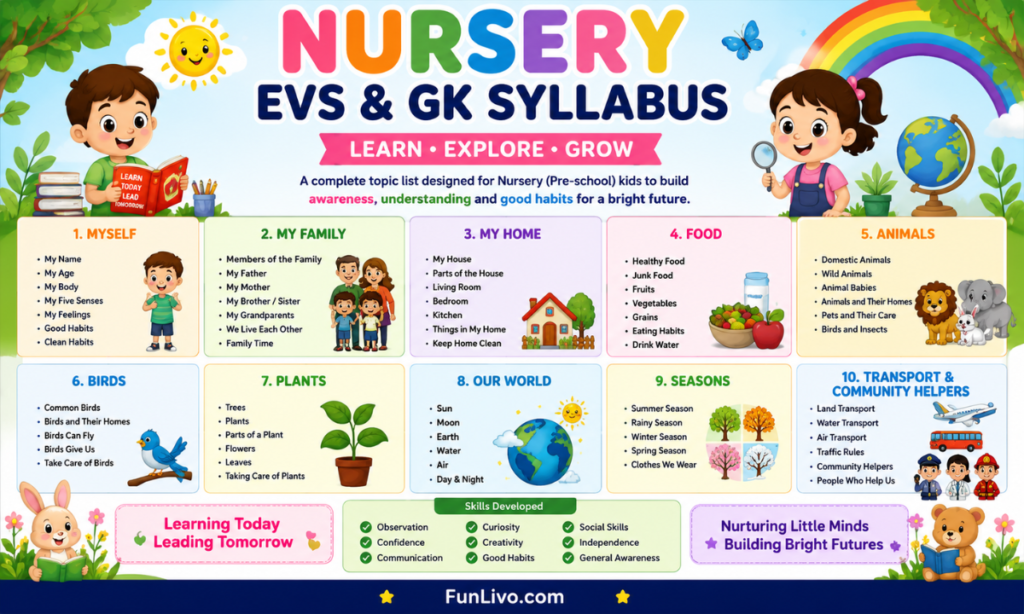
Nursery EVS and GK Syllabus: Complete Topic List for Preschool Children
Starting preschool is an exciting milestone for every child. At the nursery level, learning is not about memorizing facts or completing difficult lessons. Instead, children learn by observing, exploring, talking, playing, and asking questions.
A well-planned Nursery EVS and GK Syllabus helps children understand themselves, their family, nature, animals, food, safety, seasons, and the world around them. These early experiences build curiosity, confidence, language skills, and problem-solving abilities that prepare children for LKG and UKG.
If you are a parent or teacher wondering what topics should be included in Nursery EVS and GK, this guide will help you understand the complete syllabus in a simple way.
What is Nursery EVS?
Environmental Studies (EVS) introduces children to the world around them. Instead of reading long lessons, preschoolers learn through conversations, colorful charts, storytelling, songs, games, and everyday experiences.
A good EVS curriculum encourages children to observe, ask questions, and develop healthy habits.
Children learn to:
- Observe their surroundings
- Understand nature
- Follow daily routines
- Build good habits
- Respect people and the environment
What is Nursery GK?
General Knowledge (GK) at the nursery level focuses on helping children recognize familiar people, places, objects, animals, colors, seasons, and everyday life.
The goal is not to test memory but to develop awareness and communication skills.
Children begin learning about:
- Their family
- Community helpers
- Animals and birds
- Festivals
- National symbols
- Good manners
- Healthy habits
Nursery EVS and GK Syllabus Topics
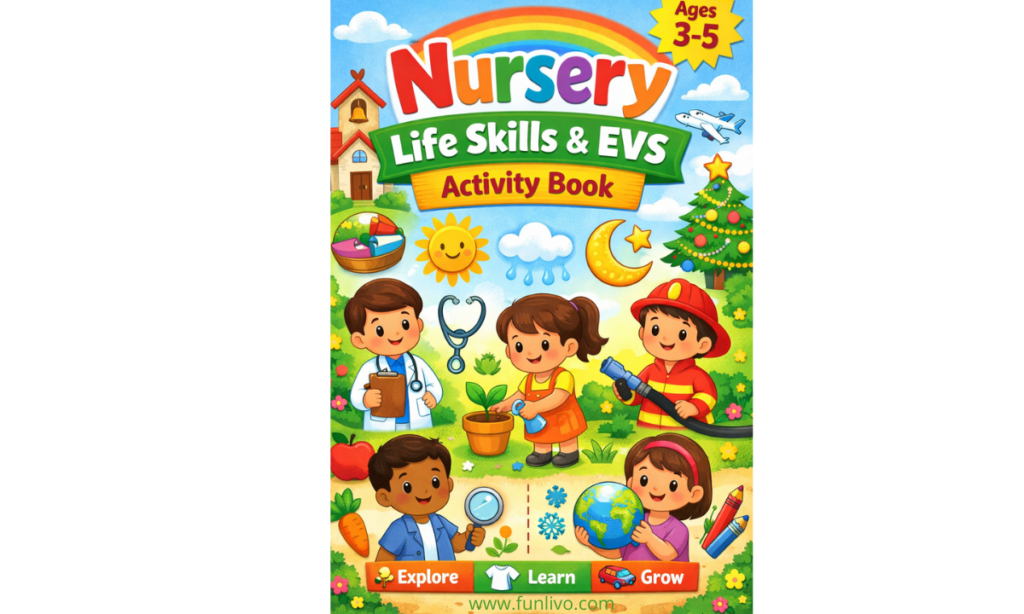
The following table covers the most common topics included in a Nursery EVS and GK syllabus.
| EVS Topics | GK Topics |
| Myself | My Name |
| My Family | Family Members |
| My Home | Good Habits |
| School | Body Parts |
| Classroom | Five Senses |
| Clothes | Fruits & Vegetables |
| Healthy Food | Animals |
| Birds | Birds |
| Plants | Flowers |
| Seasons | Colors |
| Weather | Shapes |
| Water | Transport |
| Air | Community Helpers |
| Safety Rules | National Symbols |
| Cleanliness | Festivals |
Why is the Nursery EVS and GK Syllabus Important?
Many parents think preschool is only about learning A, B, C and 1, 2, 3. In reality, children learn much more through EVS and GK.
These subjects help children understand everyday life and prepare them for future learning.
Benefits include:
- Better observation skills
- Improved vocabulary
- Strong communication
- Logical thinking
- Curiosity and confidence
- Social awareness
- Environmental responsibility
Fun Ways to Teach Nursery EVS and GK
Young children learn best through hands-on activities rather than worksheets alone.
You can make learning enjoyable by using:
- Colorful educational charts
- Flashcards
- Storytelling
- Picture books
- Nature walks
- Matching games
- Role play
- Daily conversations
- Educational worksheets
- Simple quizzes
Even a short discussion during a walk or meal can become a valuable learning opportunity.
Skills Children Develop Through EVS and GK
A well-balanced Nursery EVS and GK Syllabus supports many areas of early childhood development.
- Observation skills
- Listening skills
- Speaking confidence
- Vocabulary
- Memory
- Critical thinking
- Fine motor skills (through related activities)
- Social skills
- Self-awareness
- Environmental awareness
These skills become the foundation for future academic success.
Tips for Parents
Parents play an important role in making learning enjoyable.
Try these simple ideas at home:
- Talk about everyday objects.
- Ask open-ended questions.
- Read picture books together.
- Visit parks and gardens.
- Let children help with simple household activities.
- Encourage curiosity instead of giving quick answers.
- Use colorful charts to revise daily topics.
Learning becomes more meaningful when children see these concepts in real life.
Frequently Asked Questions
What is taught in Nursery EVS?
Nursery EVS includes topics like myself, family, home, school, plants, animals, food, clothes, seasons, transport, cleanliness, and safety.
What is included in Nursery GK?
Nursery GK covers body parts, colors, shapes, fruits, vegetables, animals, birds, festivals, community helpers, national symbols, and good habits.
What age is this syllabus suitable for?
The Nursery EVS and GK syllabus is generally designed for children aged 3–4 years.
Is this syllabus based on NEP 2020?
Most modern preschool curricula are inspired by the principles of NEP 2020 and the National Curriculum Framework for Foundational Stage (NCF-FS 2022), focusing on activity-based and play-based learning.
Related Learning Resources
To make learning more engaging, parents can also explore these preschool resources on FunLivo:
- Nursery English Worksheets
- Nursery Math Worksheets
- Hindi Varnmala Chart
- Alphabet Chart for Kids
- Color Chart for Preschool
- Good Manners Chart
- Daily Routine Chart
- Conversation Questions for Preschoolers
Conclusion
The Nursery EVS and GK Syllabus is much more than a list of topics. It helps children become curious learners who understand themselves, their surroundings, and the world around them.
With colorful charts, engaging conversations, educational activities, and consistent practice, parents and teachers can build a strong learning foundation that prepares children for future success.
Explore more preschool charts, worksheets, and printable learning resources at FunLivo and make early learning simple, joyful, and meaningful.
Educational Disclaimer
This article is intended for educational purposes. Preschool syllabus may vary slightly between schools and educational boards.