
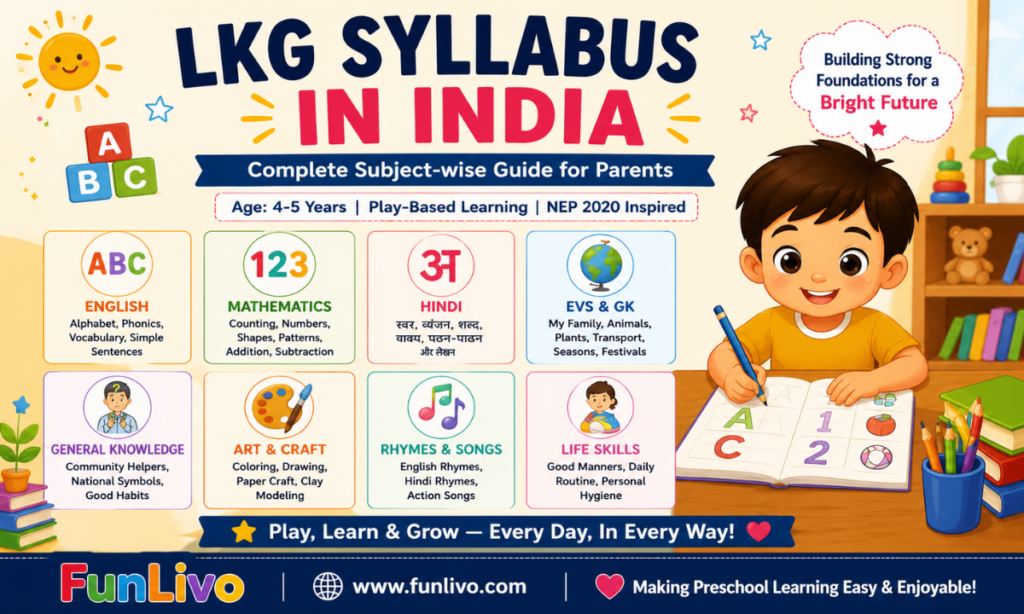
Lower Kindergarten (LKG) is one of the most important stages in a child’s early education. During this year, children begin developing stronger language, number, thinking, communication, and social skills through fun, play-based activities. Instead of focusing on memorization, the LKG Syllabus in India encourages children to explore, observe, ask questions, and learn through hands-on experiences.
If you’re a parent wondering what your child should learn in LKG, this guide will help you understand the complete subject-wise syllabus followed by most Indian preschools. While individual schools may have slight variations, the overall learning goals are similar and are inspired by play-based learning approaches and the principles of NEP 2020.
LKG Syllabus at a Glance
| Category | Details |
| Age Group | 4–5 Years |
| Class | LKG (Lower Kindergarten) |
| Curriculum | Preschool / NEP 2020 Inspired |
| Learning Method | Play-Based & Activity-Based Learning |
| Main Subjects | English, Math, Hindi, EVS, GK |
| Additional Learning | Art, Craft, Rhymes, Conversation & Life Skills |
What is the LKG Syllabus?
The LKG Syllabus in India is designed to strengthen the foundation that children build during Nursery. At this stage, children become more confident in recognizing letters, numbers, shapes, colors, and everyday objects. They also begin reading simple words, improving their vocabulary, and expressing themselves through conversations and classroom activities.
Unlike higher classes, LKG learning is not based on textbooks alone. Teachers use stories, songs, flashcards, educational charts, worksheets, puzzles, and games to make learning enjoyable and meaningful.
Why is LKG Important for Young Learners?
LKG is much more than learning the alphabet and counting numbers. It prepares children for future academic success by developing essential life skills alongside subject knowledge.
A well-planned LKG curriculum helps children:
- Improve communication skills
- Build reading readiness
- Develop early writing skills
- Strengthen number sense
- Improve observation and memory
- Learn through play and exploration
- Build confidence and independence
- Develop good classroom habits
When children enjoy learning during these early years, they are more likely to become curious and confident learners throughout school.
Complete LKG Syllabus in India
Most Indian preschools include the following subjects in the LKG curriculum.
| Subject | Topics Covered |
| English | Alphabet, Phonics, CVC Words, Vocabulary, Simple Sentences |
| Mathematics | Numbers, Counting, Shapes, Patterns, Addition, Subtraction |
| Hindi | स्वर, व्यंजन, सरल शब्द, चित्र पहचान |
| EVS | Family, Animals, Plants, Food, Seasons, Transport |
| General Knowledge | Community Helpers, Festivals, National Symbols |
| Art & Craft | Coloring, Drawing, Paper Craft |
| Rhymes | English & Hindi Rhymes |
| Life Skills | Good Manners, Daily Routine, Personal Hygiene |
Each subject focuses on developing practical skills through activities rather than rote learning.
LKG English Syllabus
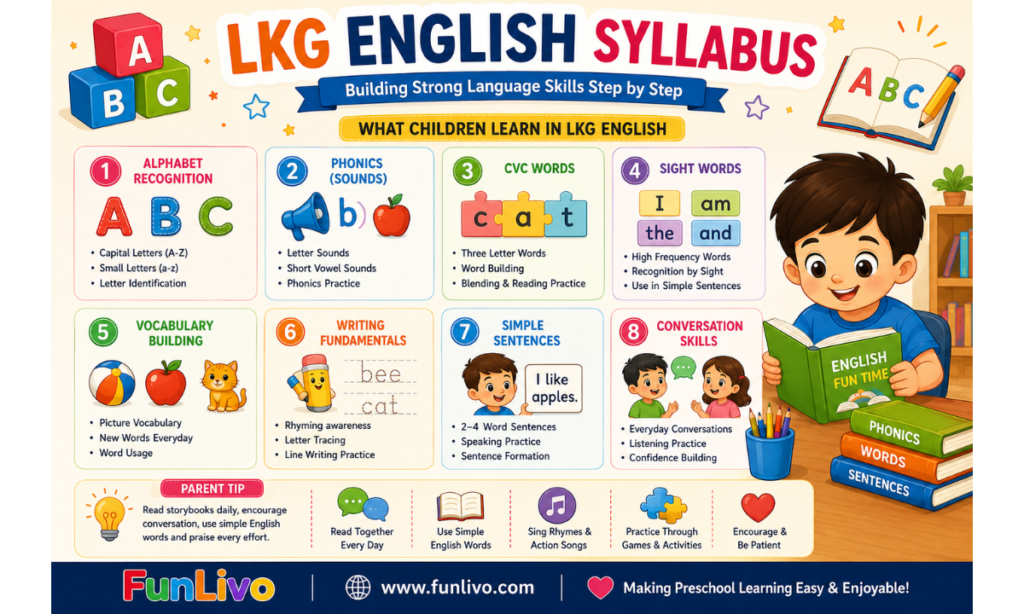
English learning in LKG helps children build confidence in listening, speaking, reading, and early writing. Instead of memorizing long lessons, children learn through stories, rhymes, pictures, conversations, and playful classroom activities.
The LKG English Syllabus generally includes:
- Capital and Small Letters
- Alphabet Recognition
- Letter Sounds (Phonics)
- CVC Words
- Rhyming Words
- Picture Reading
- Sight Words
- Vocabulary Building
- Simple English Sentences
- Basic Conversation Practice
Regular practice helps children improve pronunciation, vocabulary, and communication skills while preparing them for reading in UKG.
LKG Mathematics Syllabus
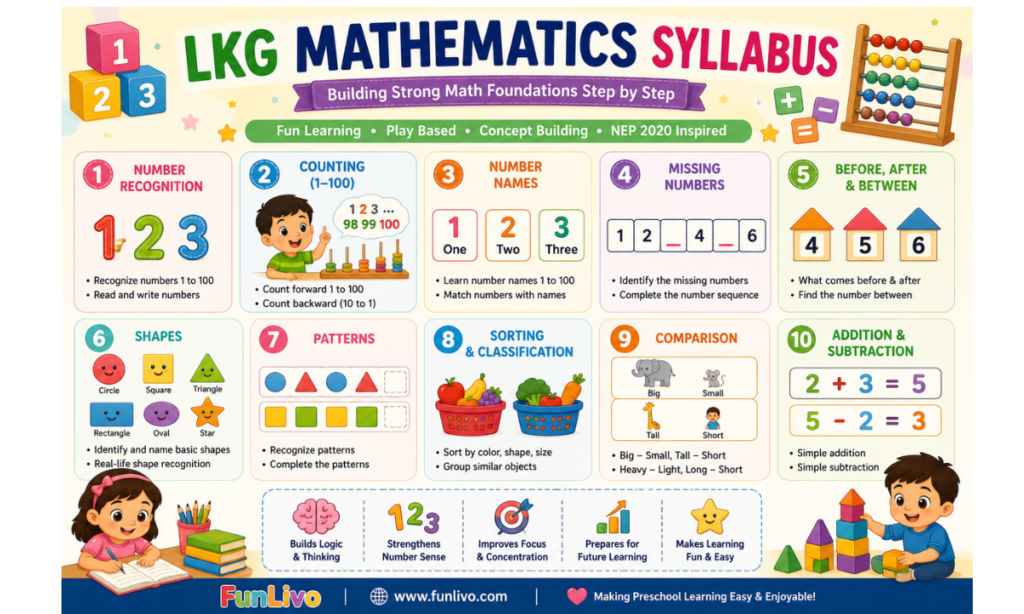
Mathematics in LKG is introduced through games, puzzles, counting activities, and hands-on learning. The goal is not to solve difficult sums but to help children understand numbers in everyday life. Children learn mathematical concepts through fun activities using objects, pictures, blocks, and educational toys.
The LKG Mathematics Syllabus usually covers:
- Counting Numbers (1–100)
- Number Recognition
- Number Names
- Missing Numbers
- Before, After & Between
- Shapes
- Patterns
- Comparison (Big–Small, Tall–Short)
- Simple Addition
- Simple Subtraction
These activities strengthen logical thinking, observation skills, and problem-solving abilities while building a strong mathematical foundation for UKG.
LKG Hindi Syllabus
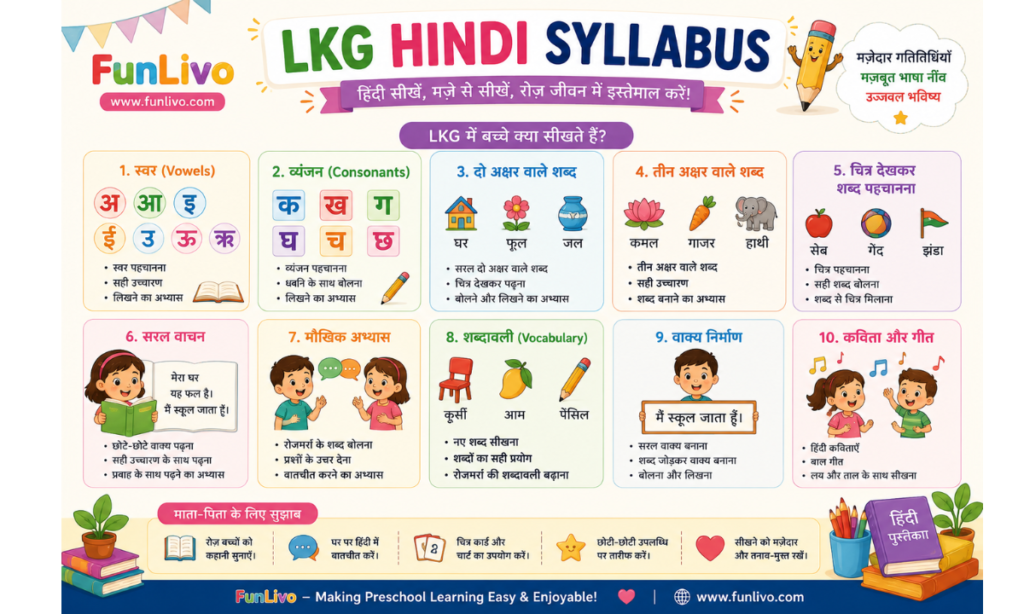
Hindi learning in LKG focuses on helping children recognize letters, improve pronunciation, and build a basic vocabulary through fun and interactive activities. At this stage, children are not expected to read long paragraphs. Instead, they become familiar with simple words and everyday language through stories, rhymes, picture reading, and classroom conversations.
A typical LKG Hindi Syllabus includes the following topics:
- स्वर (Vowels)
- व्यंजन (Consonants)
- दो अक्षर वाले शब्द
- तीन अक्षर वाले शब्द
- चित्र देखकर शब्द पहचानना
- सरल वाचन
- मौखिक अभ्यास
- शब्दावली (Vocabulary)
Learning Hindi through songs, flashcards, educational charts, and storytelling makes the process enjoyable and helps children develop confidence in speaking and reading.
Parent Tip: Practice one new Hindi word every day during daily routines. Simple conversations at home help children learn naturally without feeling pressured.
LKG EVS and General Knowledge Syllabus
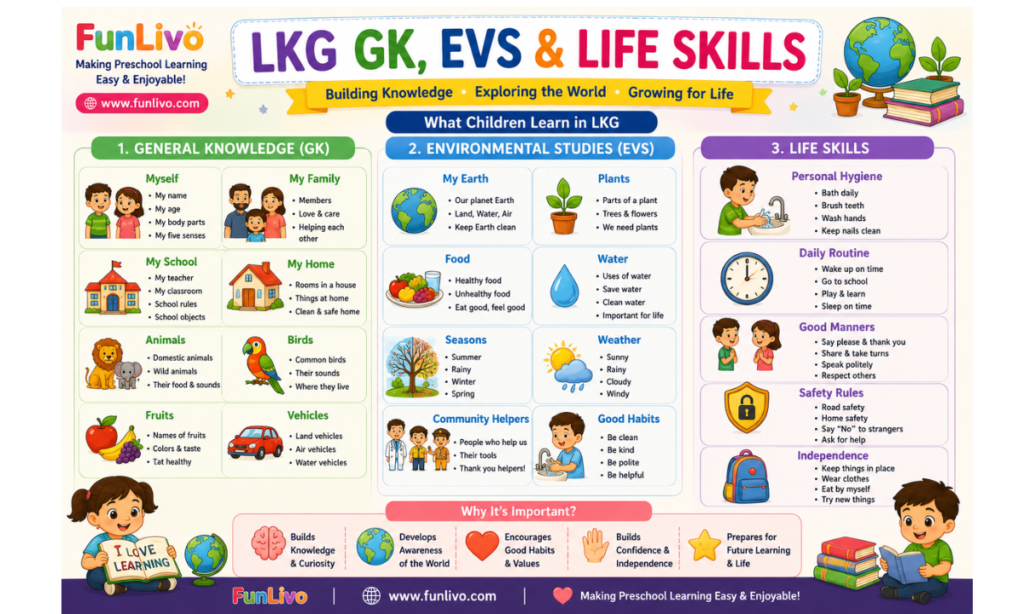
Environmental Studies (EVS) and General Knowledge (GK) encourage children to understand the world around them. Instead of memorizing facts, children learn through observation, discussion, nature walks, classroom activities, and everyday experiences.
The LKG EVS and GK Syllabus usually covers:
- Myself
- My Family
- My Home
- My School
- Community Helpers
- Animals and Birds
- Fruits and Vegetables
- Flowers and Plants
- Seasons
- Weather
- Means of Transport
- Festivals
- National Symbols
- Good Habits
- Safety Rules
These topics help children become more aware of their surroundings while improving observation, vocabulary, and communication skills.
If your child is moving from Nursery to LKG, you can also explore our detailed guide:
Art, Craft, Rhymes and Creative Activities
Creative activities are an important part of the LKG Syllabus in India because they encourage imagination, self-expression, and fine motor development. Through hands-on activities, children improve hand-eye coordination while enjoying the learning process.
Most preschools include activities such as:
- Coloring
- Drawing
- Paper Tearing
- Paper Folding
- Finger Painting
- Clay Modelling
- Craft Activities
- English Rhymes
- Hindi Rhymes
- Action Songs
These activities also help children improve concentration, creativity, and confidence while making classroom learning more engaging.
Life Skills Every LKG Child Should Learn
A good preschool curriculum goes beyond academics. It also teaches children important life skills that help them become independent and responsible.
Some essential life skills include:
- Greeting others politely
- Sharing toys with friends
- Waiting for their turn
- Washing hands before meals
- Keeping belongings organized
- Following classroom rules
- Speaking respectfully
- Helping others
- Cleaning up after activities
- Developing healthy daily habits
Teaching these habits early helps children build confidence and adjust more easily to school life.
Skills Children Develop Through the LKG Curriculum
The LKG Syllabus in India is carefully designed to support a child’s overall development, not just academic learning. Through play-based activities, children gradually build skills that prepare them for UKG and future classroom learning.
By the end of LKG, most children begin developing:
- Language and Communication Skills
- Reading Readiness
- Early Writing Skills
- Number Sense
- Logical Thinking
- Observation Skills
- Memory and Concentration
- Creativity
- Fine Motor Skills
- Social and Emotional Skills
These foundational skills help children become confident learners and make the transition to UKG much smoother.
LKG Readiness Checklist for Parents
Every child learns at their own pace, but by the end of LKG many children are able to:
✅ Recognize capital and small letters
✅ Count numbers confidently
✅ Identify basic shapes and colours
✅ Read simple three-letter words
✅ Follow simple instructions
✅ Hold a pencil correctly
✅ Speak simple English and Hindi sentences
✅ Recognize common animals, fruits, vegetables, and community helpers
This checklist is only a general guide. Every child develops differently, and small variations are completely normal.
Tips for Parents
Parents play an important role in making preschool learning enjoyable. Small daily activities often have a bigger impact than long study sessions.
Here are a few simple ways to support your child’s learning:
- Read storybooks together every day.
- Practice counting during daily activities.
- Encourage conversations in English and Hindi.
- Use colorful educational charts at home.
- Give children time to draw, colour, and create.
- Appreciate effort rather than expecting perfection.
- Keep learning playful and stress-free.
Children learn best when they feel happy, curious, and encouraged.
Frequently Asked Questions (FAQs)
What is the right age for LKG in India?
Most children start LKG between 4 and 5 years of age, although the age may vary slightly depending on the school’s admission policy.
Which subjects are included in the LKG Syllabus in India?
The LKG curriculum generally includes English, Mathematics, Hindi, EVS, General Knowledge, Art & Craft, Rhymes, Conversation Skills, and Life Skills.
Is the LKG syllabus the same in every school?
No. Different schools may follow slightly different curricula, but most include similar learning outcomes based on play-based preschool education and the principles of NEP 2020.
How can parents prepare children for LKG?
Parents can support learning through storytelling, educational games, printable worksheets, daily conversations, and hands-on activities rather than relying only on textbooks.
Are worksheets enough for LKG learning?
Worksheets are excellent for practice, but they should be combined with play, storytelling, creative activities, conversations, and real-life experiences to provide balanced early childhood learning.
Conclusion
The LKG Syllabus in India provides children with a strong foundation in language, mathematics, environmental awareness, creativity, and essential life skills. Rather than focusing on memorization, it encourages children to learn through play, exploration, conversations, and meaningful activities that make learning enjoyable.
Whether you are a parent, teacher, or homeschool educator, understanding the LKG curriculum helps you support your child’s overall development with confidence. By combining educational charts, printable worksheets, storytelling, games, and everyday learning opportunities, you can create a positive learning environment that prepares children for UKG and beyond.
The topics covered in this guide are broadly aligned with the principles of the National Curriculum Framework for Foundational Stage (NCF-FS 2022), which emphasizes play-based, activity-based, and holistic learning for children aged 3–8 years.
Looking for fun and engaging LKG learning resources? Explore FunLivo’s printable worksheets, educational charts, and preschool activities to make learning simple, screen-free, and enjoyable for every young learner.