
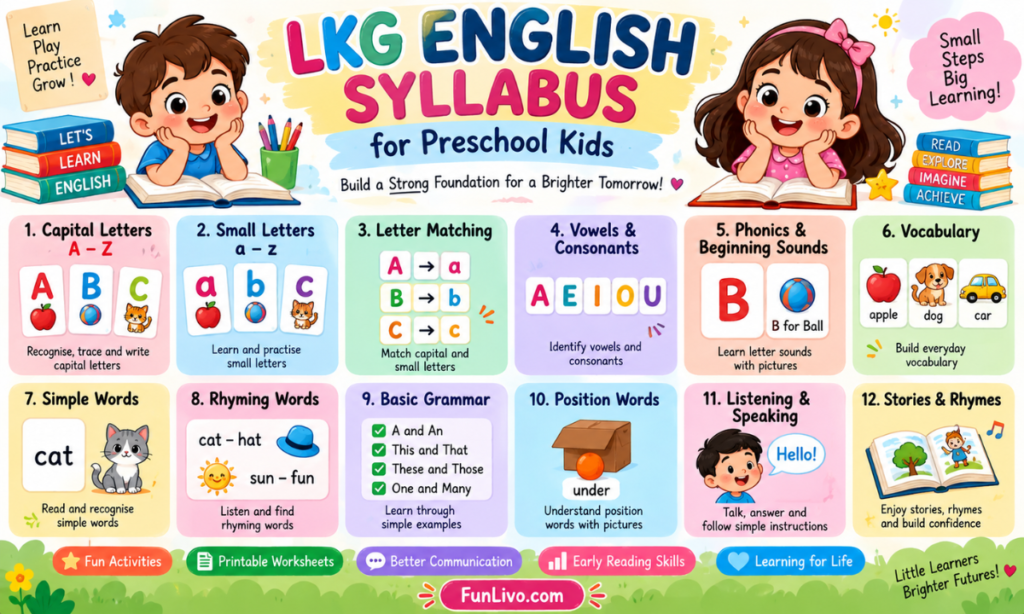
LKG English Syllabus for Preschool Kids’ Skills and Topics
The LKG English Syllabus for Preschool Kids introduces children to early English language and literacy through letters, sounds, vocabulary, simple words, rhymes, stories and writing practice. At this stage, children gradually move from basic alphabet recognition toward recognising capital and small letters, connecting letters with sounds and developing early reading and writing skills.
Early English learning should build more than letter-writing. Foundational language development also includes listening, speaking, vocabulary, phonological awareness, and gradual development of reading and writing skills.
The exact sequence may vary from school to school, but this guide covers the common English learning areas generally introduced at the LKG level.
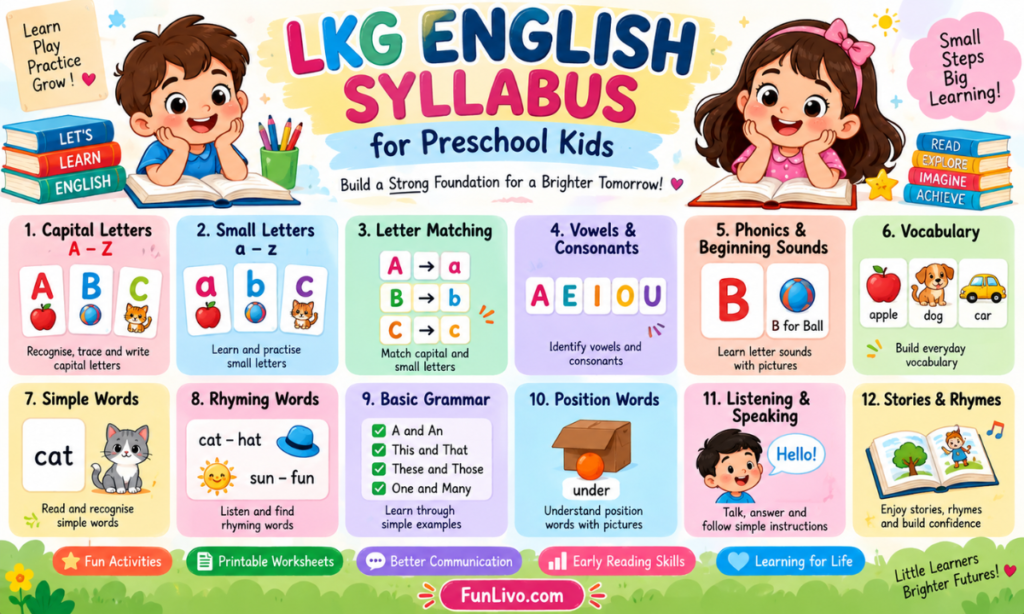
LKG English Syllabus: Main Topics
The LKG English Syllabus for Preschool Kids can be broadly divided into the following areas:
- Capital letters A–Z
- Small letters a–z
- Letter recognition
- Letter tracing and writing
- Vowels and consonants
- Beginning sounds
- Basic phonics
- Simple vocabulary
- Picture-word matching
- Rhyming words
- Simple words
- Listening and speaking
- Stories and rhymes
- Basic language concepts
- Early reading readiness
These areas help children build the foundation needed for later reading and writing.
1. Capital and Small Letters
In LKG, children continue practising the alphabet and become more familiar with both uppercase and lowercase letters.
Children can learn to:
- Recognise A–Z
- Recognise a–z
- Match capital and small letters
- Trace letters
- Practise correct letter formation
- Identify a particular letter from a group
For example:
| Capital Letter | Small Letter |
| A | a |
| B | b |
| C | c |
| D | d |
| E | e |
Compared with Nursery, where children may mainly be introduced to capital letters and basic letter recognition, LKG can place more emphasis on capital-small letter matching and independent writing practice.
2. Vowels and Consonants
Children can be introduced to the five common vowels:
A, E, I, O, U
Simple activities can include:
- Finding vowels
- Matching vowels with pictures
- Identifying vowels in simple words
- Tracing vowels
- Sorting vowels and other letters
Children can also become familiar with consonants through alphabet and sound activities.
3. Phonics and Beginning Sounds
Phonics activities help children connect letters with their sounds.
Examples include:
- B – /b/ – ball
- C – /k/ – cat
- D – /d/ – dog
- M – /m/ – moon
Beginning-sound activities can ask children to identify the first sound in a familiar word.
For example:
Sun → S
Fish → F
Ball → B
The aim at this level is simple sound awareness and early letter-sound connection rather than advanced phonics rules.
NCERT’s foundational-stage framework includes phonological awareness and letter-sound relationships as important parts of early literacy development.
4. Vocabulary and Simple Words
Vocabulary is an important part of the LKG English Syllabus for Preschool Kids.
Children can learn familiar words related to:
- Family
- Body parts
- Animals
- Fruits and vegetables
- Food
- Clothes
- Toys
- School
- Colours
- Shapes
- Numbers
- Home
- Nature
Children can gradually recognise and use simple words such as:
cat, dog, ball, sun, bus, pen, cup, red, blue, big and small.
Picture-based activities and matching worksheets can make vocabulary practice easier and more engaging.
5. Rhyming Words
Rhyming activities help children notice similar sounds in words.
Simple examples include:
- cat – hat
- sun – fun
- dog – log
- hen – pen
- ball – tall
Children can practise matching pictures, identifying rhyming pairs and completing simple rhyming activities.
6. Basic Language Concepts
The LKG English Syllabus for Preschool Kids may also introduce simple language concepts through pictures and everyday examples.
A and An
- a cat
- a ball
- an apple
- an egg
This and That
- This is a ball.
- That is a tree.
One and Many
- one apple → many apples
- one book → many books
Position Words
Children can also become familiar with simple words such as:
in, on, under, above, below, near, behind and beside.
These concepts are better introduced through pictures, objects and simple sentences rather than lengthy grammar exercises.
7. Listening, Speaking, Stories and Rhymes
English learning at LKG should include more than writing worksheets.
Children can practise:
- Listening to short stories
- Answering simple questions
- Naming familiar objects
- Talking about pictures
- Following simple instructions
- Saying short sentences
- Reciting rhymes
- Participating in conversations
Stories, picture books and rhymes help children develop vocabulary and confidence in using English.
The foundational-stage framework also emphasises oral language, vocabulary, reading and writing as connected areas of early language development.
Nursery to LKG English Progression
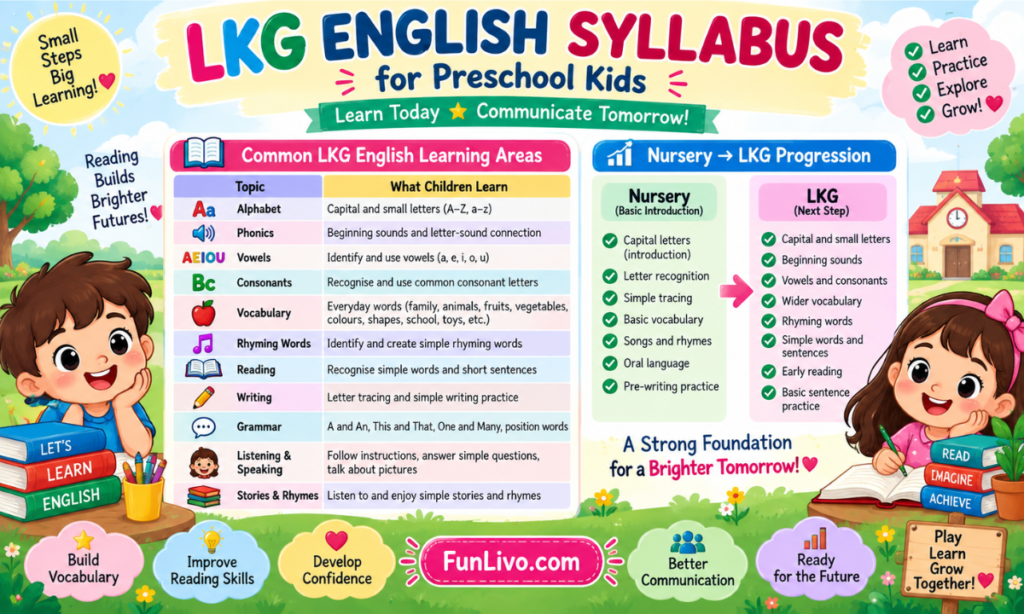
| Nursery | LKG |
| Basic alphabet introduction | Stronger A–Z recognition |
| Mainly capital-letter practice | Capital and small letters |
| Simple tracing | More controlled letter writing |
| Basic vocabulary | Wider vocabulary |
| Songs and rhymes | Rhyming and sound activities |
| Letter recognition | Letter-sound connection |
| Pre-writing practice | Letter formation and writing |
| Simple picture activities | Early phonics and word activities |
This is a general progression, not a fixed rule for every child or school. Children develop foundational language skills at different rates.
LKG English Worksheets for Practice
Worksheets can provide short, focused practice for the topics covered in the LKG English Syllabus for Preschool Kids.
Useful worksheet types include:
- Alphabet worksheets
- Capital and small letter worksheets
- Letter tracing worksheets
- Vowel worksheets
- Beginning-sound worksheets
- Phonics worksheets
- Picture-word matching
- Vocabulary worksheets
- Rhyming-word worksheets
- Missing-letter worksheets
- Simple-word worksheets
- Position-word worksheets
- A and An worksheets
You can explore our English Worksheets for Preschool Kids for printable activities covering alphabet, tracing, phonics, vocabulary and other early-learning skills.
LKG English Learning Checklist
By the LKG stage, children can gradually work toward:
- Recognising capital letters A–Z
- Recognising small letters a–z
- Matching uppercase and lowercase letters
- Tracing and writing familiar letters
- Recognising common letter sounds
- Identifying beginning sounds
- Recognising common vowels
- Understanding everyday vocabulary
- Recognising some simple words
- Identifying simple rhyming words
- Following simple instructions
- Listening to short stories
- Participating in rhymes and conversations
These should be treated as developmental learning goals rather than a strict checklist that every child must complete at exactly the same age.
Frequently Asked Questions
What is included in the LKG English Syllabus for Preschool Kids?
The LKG English Syllabus for Preschool Kids generally covers capital and small letters, letter writing, vowels, consonants, phonics, beginning sounds, vocabulary, rhyming words, simple language concepts, listening, speaking, stories and early reading skills.
Should LKG children learn capital and small letters?
Yes. Children can gradually learn to recognise, match, trace and write both uppercase and lowercase letters.
Is phonics included in the LKG English Syllabus for Preschool Kids?
Early phonics and letter-sound activities are useful for developing sound awareness and early literacy. Children can begin with familiar letters, sounds and pictures.
Is the LKG English syllabus the same in every school?
No. Schools may organise their LKG English curriculum differently. The LKG English Syllabus for Preschool Kids presented here is a practical guide to common early English learning areas.
How can parents support LKG English learning?
Parents can use storybooks, conversations, rhymes, picture activities, alphabet games, phonics practice and short worksheets. Regular, playful practice is more appropriate than long study sessions.
Final Thoughts
A good LKG English Syllabus for Preschool Kids should gradually take children from letters to sounds, sounds to words and words toward early reading and writing.
The focus should be on building a strong foundation through letters, phonics, vocabulary, stories, rhymes, conversation and age-appropriate writing practice.
Looking for an easy way to practise the LKG English basics at home? Our LKG English Foundation Book brings essential early-English practice together in a simple, child-friendly format.
Note: This LKG English syllabus is a general educational guide designed to support children’s basic language and literacy foundations. It does not follow or represent the official syllabus of any specific school, board, or education system.