LKG EVS and GK Syllabus for Preschool Kids
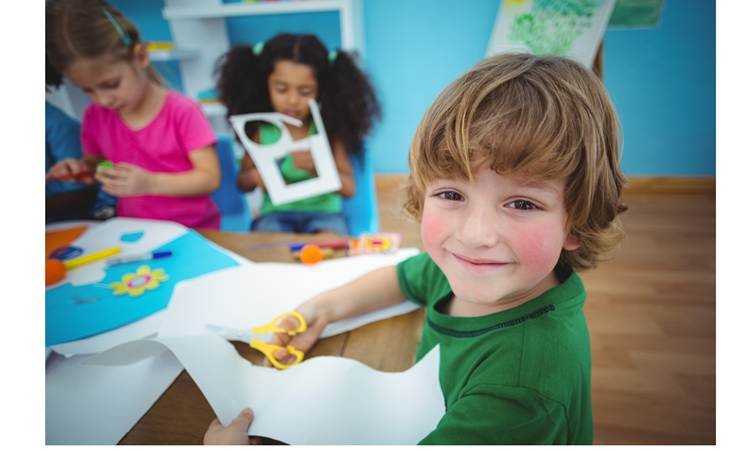
The LKG EVS and GK Syllabus for preschool kids introduces children to the world around them through simple, familiar topics such as family, body parts, animals, plants, food, transport, seasons, safety, and community helpers. At this stage, children learn best by observing, talking, asking questions, and participating in everyday activities rather than memorising long lists of facts. NAEYC also highlights observation, curiosity, exploration, and meaningful experiences as important parts of early science and social studies learning.
There is no single universal LKG syllabus followed by every school. Topics and their order can vary, but the LKG EVS and GK Syllabus below brings together the common themes generally introduced at this level.
What Is Covered in the LKG EVS and GK Syllabus?
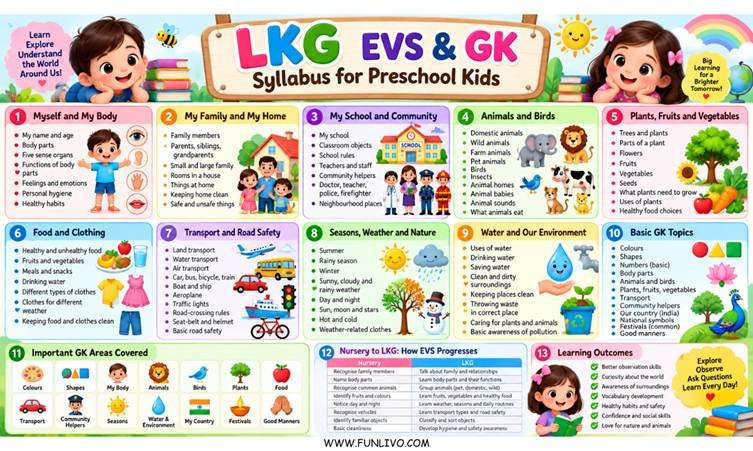
The syllabus generally moves from topics children know personally such as themselves, their family, and school to the wider world of animals, plants, nature, transport, and community.
1. Myself and My Body
Children begin with familiar information about themselves.
- My name, age and basic introduction
- Parts of the body
- Five sense organs
- Simple functions of body parts
- Feelings and emotions
- Personal hygiene
- Healthy habits
- Keeping the body clean
- Basic food and health awareness
Children can learn these concepts through songs, picture cards, conversations, matching activities, and simple worksheets.
2. My Family and My Home
Family and home are important parts of early social learning.
- Family members
- Parents, siblings and grandparents
- Small and large families
- Different rooms in a home
- Things found at home
- Keeping the home clean
- Safe and unsafe things at home
Rather than expecting children to memorise definitions, parents and teachers can connect these topics with the child’s own experiences.
3. My School and Community
The LKG EVS and GK Syllabus also helps children understand places and people they see regularly.
- My school
- Classroom objects
- School rules
- Teachers and other school staff
- Community helpers
- Doctor
- Teacher
- Police officer
- Firefighter
- Post office and other familiar services
- Neighbourhood places
NAEYC notes that young children can meaningfully explore families, classrooms, neighbourhoods, and communities as part of early social-studies learning.
4. Animals and Birds
Children are naturally interested in animals, making this an engaging EVS topic.
- Domestic animals
- Pet animals
- Wild animals
- Farm animals
- Birds
- Insects
- Animal homes
- Animal babies
- Animal sounds
- What animals eat
- Basic differences between animals
Activities such as matching animals with their homes, identifying sounds, colouring pictures, and sorting domestic and wild animals can make the topic easier to understand.
5. Plants, Fruits and Vegetables
The LKG EVS and GK Syllabus commonly introduces children to the plants and food they see around them.
- Trees and plants
- Parts of a plant
- Flowers
- Fruits
- Vegetables
- Seeds
- What plants need to grow
- Common uses of plants
- Healthy food choices
Simple observation is particularly useful here. A child can observe a leaf, flower, seed, or growing plant and talk about what they notice. NAEYC recommends using everyday nature experiences to encourage children’s scientific curiosity and questioning.
6. Food and Clothing
Children can learn about everyday needs through simple examples.
- Healthy and unhealthy food
- Fruits and vegetables
- Meals and snacks
- Drinking water
- Different types of clothes
- Clothes for different weather
- Keeping food and clothes clean
7. Transport and Road Safety
This section introduces children to vehicles and basic safety rules.
- Land transport
- Water transport
- Air transport
- Car, bus, bicycle and train
- Boat and ship
- Aeroplane
- Traffic lights
- Road-crossing rules
- Seat-belt and helmet awareness
- Basic road safety
The focus should remain on simple recognition and safe habits rather than detailed traffic rules.
8. Seasons, Weather and Nature
Children gradually become aware of changes in their surroundings.
- Summer
- Rainy season
- Winter
- Sunny, cloudy and rainy weather
- Day and night
- Sun, moon and stars
- Hot and cold
- Basic weather-related clothing
Nature walks and conversations about the weather can turn these concepts into real experiences. NAEYC describes young children as active observers of nature, weather, plants, and their surroundings.
9. Water and Our Environment
Basic environmental awareness can also be introduced at LKG level.
- Uses of water
- Drinking water
- Saving water
- Clean and dirty surroundings
- Keeping places clean
- Throwing waste in the correct place
- Caring for plants and animals
- Basic awareness of pollution
These concepts are best taught through everyday actions rather than complicated explanations.
10. Basic GK Topics for LKG
General Knowledge activities can introduce children to simple facts and recognition skills.
| GK Area | Common Topics |
| Colours | Basic and common colours |
| Shapes | Circle, square, triangle, rectangle |
| Body | Body parts and five senses |
| Animals | Domestic, wild and farm animals |
| Birds | Common birds |
| Plants | Trees, flowers, fruits and vegetables |
| Transport | Road, water and air transport |
| Community | Common helpers and familiar places |
| Nature | Sun, moon, stars, weather |
| Time | Day, night, morning and evening |
| Food | Fruits, vegetables and healthy foods |
| Safety | Home, school and road safety |
Nursery to LKG: How Does EVS Progress?
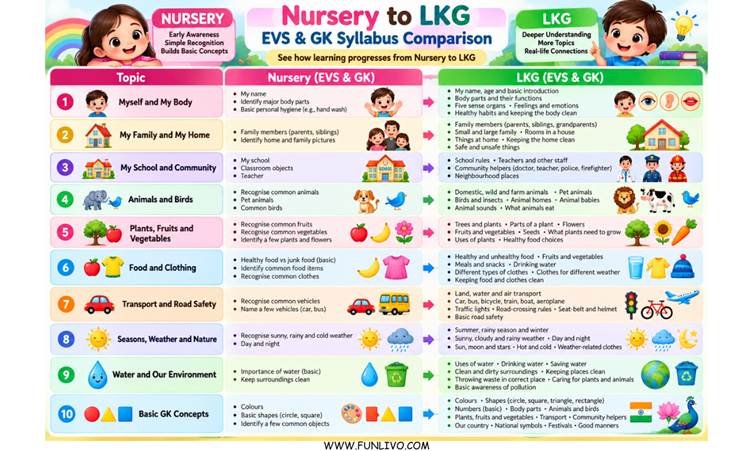
The LKG EVS and GK Syllabus generally builds on the awareness children begin developing in Nursery.
| Nursery | LKG |
| Recognise family members | Talk about family and relationships |
| Name common body parts | Learn body parts and their simple functions |
| Recognise common animals | Group animals as pet, domestic and wild |
| Identify common fruits | Learn fruits, vegetables and healthy food |
| Recognise basic colours | Identify and classify more colours |
| Notice day and night | Learn simple weather, seasons and daily routines |
| Recognise familiar vehicles | Learn transport types and basic road safety |
| Identify familiar objects | Classify objects by simple features |
| Basic cleanliness habits | Develop hygiene and safety awareness |
The progression is not about making the child memorise more information. It is about moving from recognition to understanding, conversation, classification, and simple real-world connections.
How to Teach LKG EVS and GK
EVS becomes much easier when children can see, touch, discuss, and explore the concepts.
Try activities such as:
- Nature walks and observation
- Picture sorting
- Animal and plant matching
- Body-part songs
- Show-and-tell
- Role-play for community helpers
- Simple safety demonstrations
- Weather charts
- Fruit and vegetable sorting
- Printable worksheets
- Storybooks and picture conversations
For young children, real-life experiences can make science and social studies more meaningful than isolated memorisation.
LKG EVS and GK Worksheets
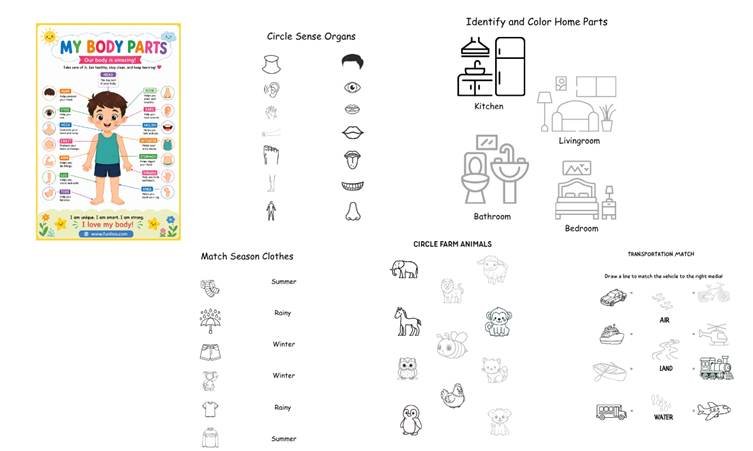
Worksheets can reinforce what children have already discussed or observed. Suitable activities include matching, colouring, identifying, sorting, tracing, circling, odd-one-out, and simple picture-based questions.
For example, a child might match an animal with its home, identify five sense organs, sort fruits and vegetables, or circle objects that are safe.
You can explore our EVS & GK worksheets for preschool kids for printable practice covering topics commonly introduced at Nursery and LKG levels.
Frequently Asked Questions
What does the LKG EVS and GK Syllabus include?
The LKG EVS and GK Syllabus commonly includes myself and my body, family, home, school, animals, birds, plants, fruits, vegetables, transport, safety, seasons, weather, food, community helpers, cleanliness, and basic general knowledge.
Is there one fixed LKG EVS syllabus for every school?
No. LKG syllabi can differ between schools. The topics in this guide represent common themes rather than one compulsory school syllabus.
How can I prepare my child for LKG EVS?
Start with everyday conversations and experiences. Talk about body parts, family, animals, plants, weather, food, transport, and safety while using pictures, stories, games, and simple worksheets.
Should LKG children memorise GK facts?
At this age, understanding and recognising familiar concepts is more useful than memorising long lists. Children benefit from opportunities to observe, ask questions, explore, and talk about what they discover.
What is the difference between EVS and GK at LKG level?
EVS mainly helps children understand themselves and their environment, while GK activities introduce simple facts and recognition about the world around them. At preschool level, the two areas naturally overlap.
Practice LKG EVS & GK with Printable Worksheets
Want to help your child practice EVS, GK, life skills, colors, and everyday concepts through fun, screen-free activities?
Our Preschool EVS Worksheets Bundle for Kids includes 200+ printable worksheets for children ages 3–6, covering EVS, GK, life skills, color identification, and scissor-cutting practice.
What’s included:
- 75+ LKG EVS & GK worksheets
- Nursery Life Skills & EVS activities
- Color identification worksheets
- Scissor-cutting practice
- Printable PDF format
- Suitable for ages 3–6
Get the complete bundle here:
👉 Preschool EVS Worksheets Bundle for Kids | Ages 3–6
₹149 | 200+ Printable Worksheets | 4 Workbooks in 1 Bundle
Final Note
This LKG EVS and GK Syllabus is a practical general guide for parents and teachers. Individual schools may arrange topics differently or include additional themes. The goal at this age should be to build curiosity, vocabulary, observation, awareness, and confidence through meaningful everyday learning.