
Complete Nursery Math Syllabus in India: Skills Your Child Should Learn at Age 3–4.
Why Nursery Math Is Important for Young Children.
Math Nursery Syllabus in India (Age 3–4 Years)
Number Recognition and Counting Skills.
Shapes and Spatial Awareness in Nursery Math.
Comparison and Measurement Concepts.
Patterns and Logical Thinking.
Writing Readiness for Numbers (Optional)
How Parents Can Support Nursery Math at Home.
Frequently Asked Questions (FAQs)
Complete Nursery Math Syllabus in India: Skills Your Child Should Learn at Age 3–4

When parents hear the word math, they often imagine numbers, sums, and pressure. But at the nursery level (age 3–4), math is not about calculations. It is about thinking skills, observation, patterns, and everyday understanding.
I can confidently say that children who get the right math foundation in nursery feel confident, curious, and stress-free when they enter LKG and UKG.
This article explains the Math Nursery syllabus in India, what skills your child should actually learn at this age, and how parents can support learning at home in a simple, practical way.
Why Nursery Math Is Important for Young Children
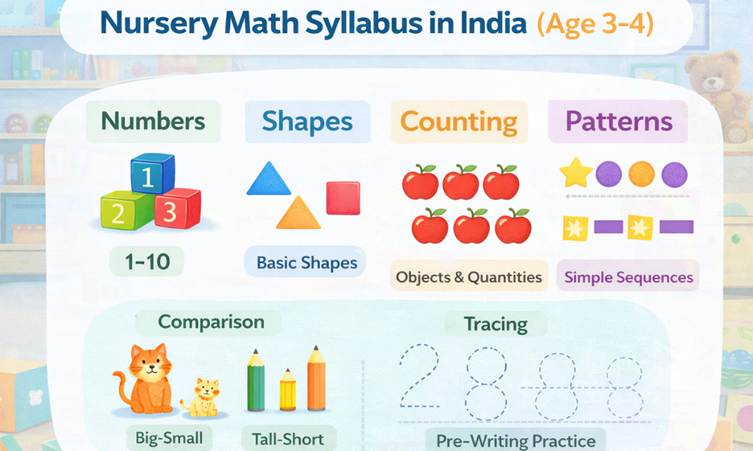
At age 3–4, a child’s brain develops very fast. Nursery math helps children make sense of the world around them through numbers, shapes, and comparisons.
According to India’s National Education Policy (NEP 2020), early learning should focus on foundational numeracy rather than rote learning. The goal is to help children understand, not memorize.
Nursery math builds:
- Logical thinking
- Problem-solving ability
- Observation skills
- Confidence in learning
Research also shows that children exposed to early numeracy develop stronger academic skills later in life.
Math Nursery Syllabus in India (Age 3–4 Years)
The Math Nursery syllabus in India is designed to be activity-based and playful. Schools may vary slightly, but the core learning areas remain the same.
At this stage, children should not be forced to write numbers repeatedly. Instead, learning should happen through pictures, objects, games, and worksheets.
The syllabus focuses on understanding concepts rather than performance.
Number Recognition and Counting Skills
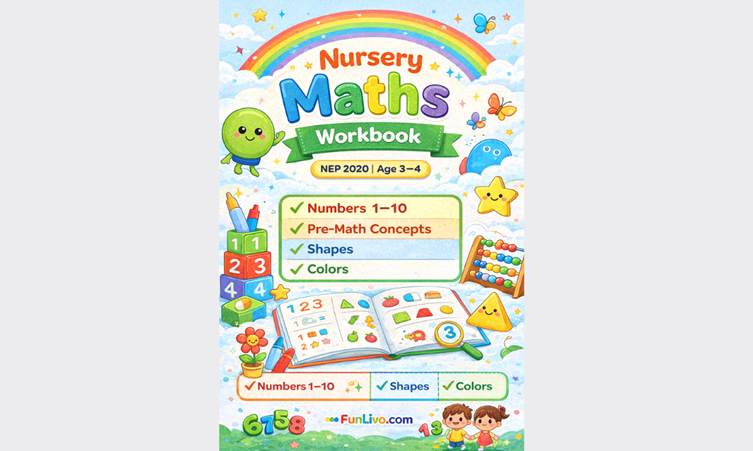
This is the first step of nursery math. Children learn to identify numbers and connect them with real objects.
Key skills include:
- Recognizing numbers 1 to 10
- Counting objects up to 5 or 10
- Understanding “how many” through visuals
- Matching numbers with quantities
For example, if a child sees the number 3, they should be able to count three apples or three toys.
Educational experts recommend using hands-on activities for this stage rather than books alone.
At home, parents can practice this using toys, fruits, or daily household items.
Shapes and Spatial Awareness in Nursery Math
Shapes are a very important part of nursery-level math because they improve visual and spatial thinking.
Children should learn to:
- Identify basic shapes (circle, square, triangle, rectangle)
- Match similar shapes
- Find shapes in everyday objects
- Sort objects based on shape
For example:
- A plate looks like a circle
- A book looks like a rectangle
This kind of learning helps children connect math with real life.
According to early learning research, spatial skills are directly linked to later success in math and science.
Comparison and Measurement Concepts
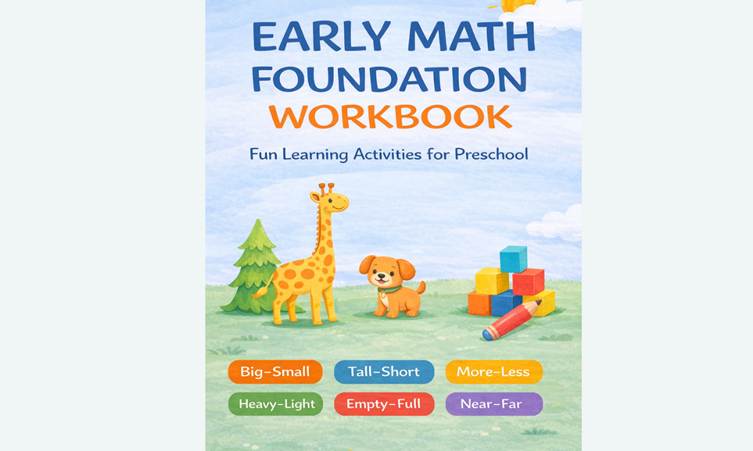
Comparison skills help children understand differences and relationships between objects.
In the nursery math syllabus, children are introduced to:
- Big and small
- Tall and short
- Heavy and light
- More and less
These concepts should always be taught through visual comparison, not explanation.
For example:
- Which glass has more water?
- Which pencil is longer?
These simple questions build critical thinking without pressure.
This is where practice worksheets are very helpful, as they allow children to observe and choose answers visually instead of writing.
Patterns and Logical Thinking
Patterns are one of the most enjoyable parts of nursery math for children.
Children learn to:
- Recognize simple patterns (AB, AAB)
- Complete missing patterns
- Identify patterns in colors, shapes, and objects
Examples:
- Red–Blue–Red–Blue
- Circle–Circle–Square
Pattern activities improve:
- Memory
- Sequencing skills
- Problem-solving ability
Experts in early education consider pattern recognition a foundation for algebraic thinking later on.
Writing Readiness for Numbers (Optional)
Not all nursery children are developmentally ready to write numbers, and that is completely normal.
At this stage, focus should be on:
- Tracing numbers with guidance
- Holding a pencil correctly
- Developing hand strength through coloring and tracing
Forced writing can create fear and resistance. Instead, gentle tracing activities help children prepare naturally for LKG.
If you are using worksheets, choose ones that focus on guided tracing, not full writing.
How Parents Can Support Nursery Math at Home
Parents play a very important role in making math enjoyable.
Simple daily activities can help:
- Count steps while climbing stairs
- Sort toys by size or color
- Identify shapes during a walk
- Compare fruits and vegetables while cooking
Short, playful practice works much better than long study sessions.
If you are looking for structured, age-appropriate practice, a complete nursery math worksheet bundle can save time and ensure your child practices the right skills without confusion.
Frequently Asked Questions About Math Nursery syllabus in India
Q1. What is the right age to start nursery math?
Age 3 is ideal to start nursery math through play-based activities and visual learning.
Q2. Should my child write numbers in nursery?
Writing is optional. Focus on recognition, counting, and tracing readiness.
Q3. How many numbers should a nursery child learn?
Usually numbers 1 to 10 are enough, with proper understanding.
Q4. Are worksheets good for nursery children?
Yes, if they are simple, visual, and practice-focused, not exam-orientated.
Q5. How much daily practice is enough?
10–15 minutes a day is more than sufficient at this age.
Disclaimer
This article Math Nursery syllabus in India is for educational guidance only. Every child develops at their own pace, and learning expectations should always be adapted to the child’s comfort and interest level.